Misreading Misreading
Exhibited on Kaurna Country at The Floating Goose, Adelaide, South Australia
21 November - 14 December 2025
This project was proudly and generously supported by The Government of South Australia and Forage Supply Co.
Exhibition photography: Rosina Possingham
-
Graffiti isn’t written by wrist and fingers, it is scrawled from the arm and shoulder. The resulting word/phrase/symbol has an embedded time signature of urgency, right now. A lot of graffiti isn’t completely legible, either on purpose or as a result of the artist’s chosen medium. Some works seem closer to a visual pattern, lace-like or even florid. The act of writing (or scrawling) across the external surface of a building transforms a city into a giant ledger book or noticeboard. What types of messages are urgent enough to warrant graffiti? The blunt, crude, and non-sensical sit democratically alongside the political and poetic.
We think of graffiti in terms of contemporary aerosol and marker tangles, but going back hundreds of years, graffiti also shows up as engravings – a much more time and labour-intensive medium. The persistence of graffiti across time and culture shows our collective impulse to mark, footnote, question, subvert and chide dominant culture.
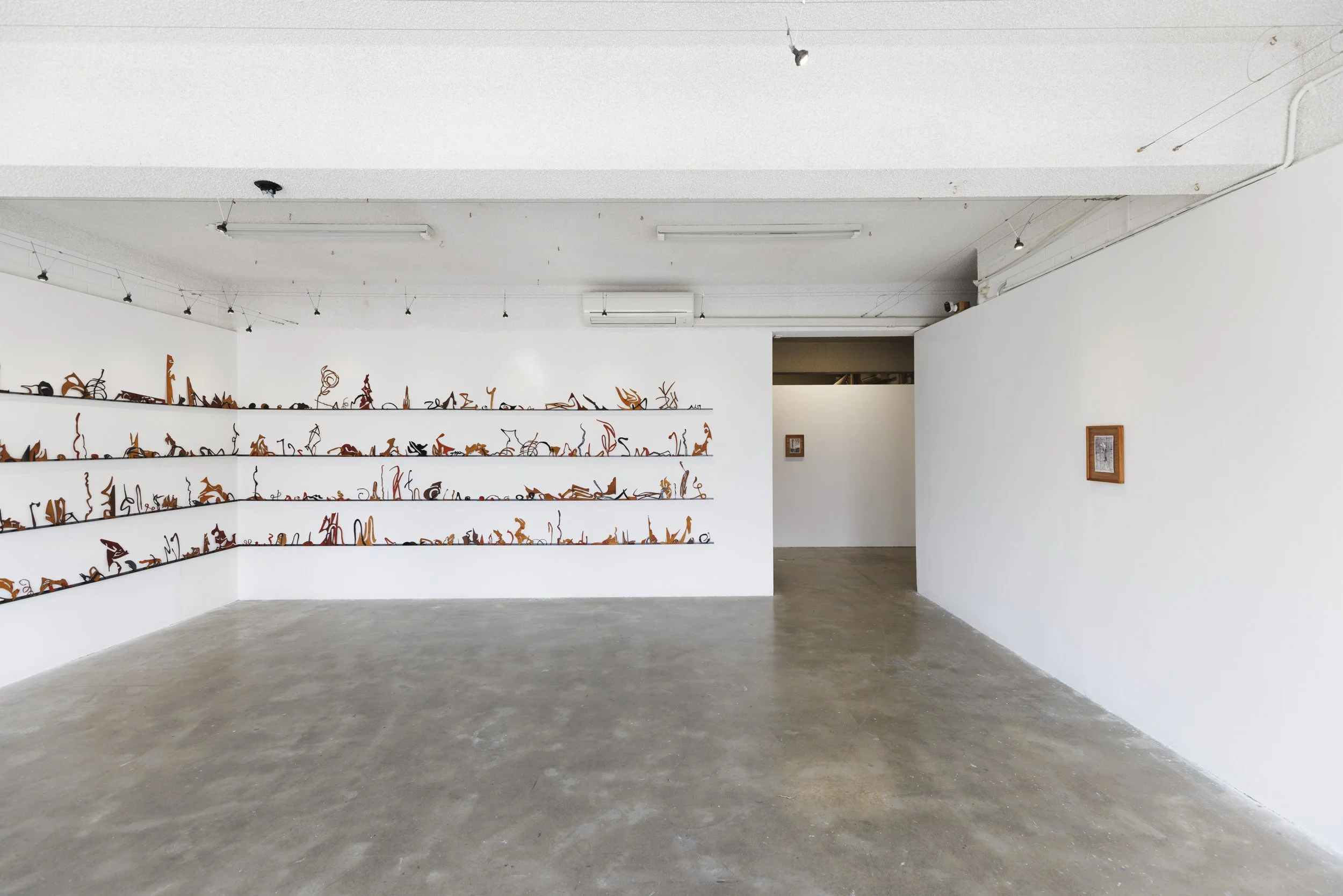
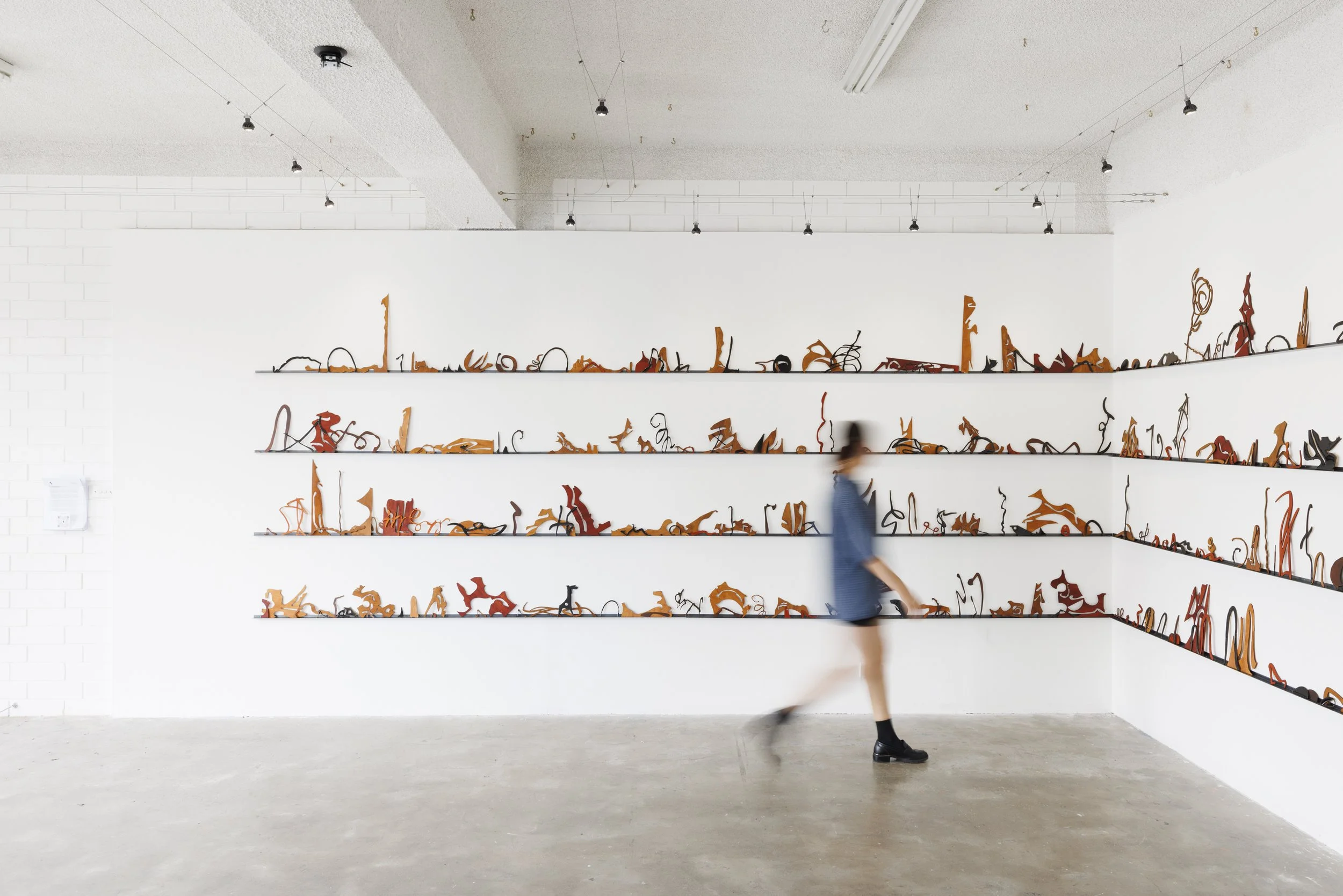
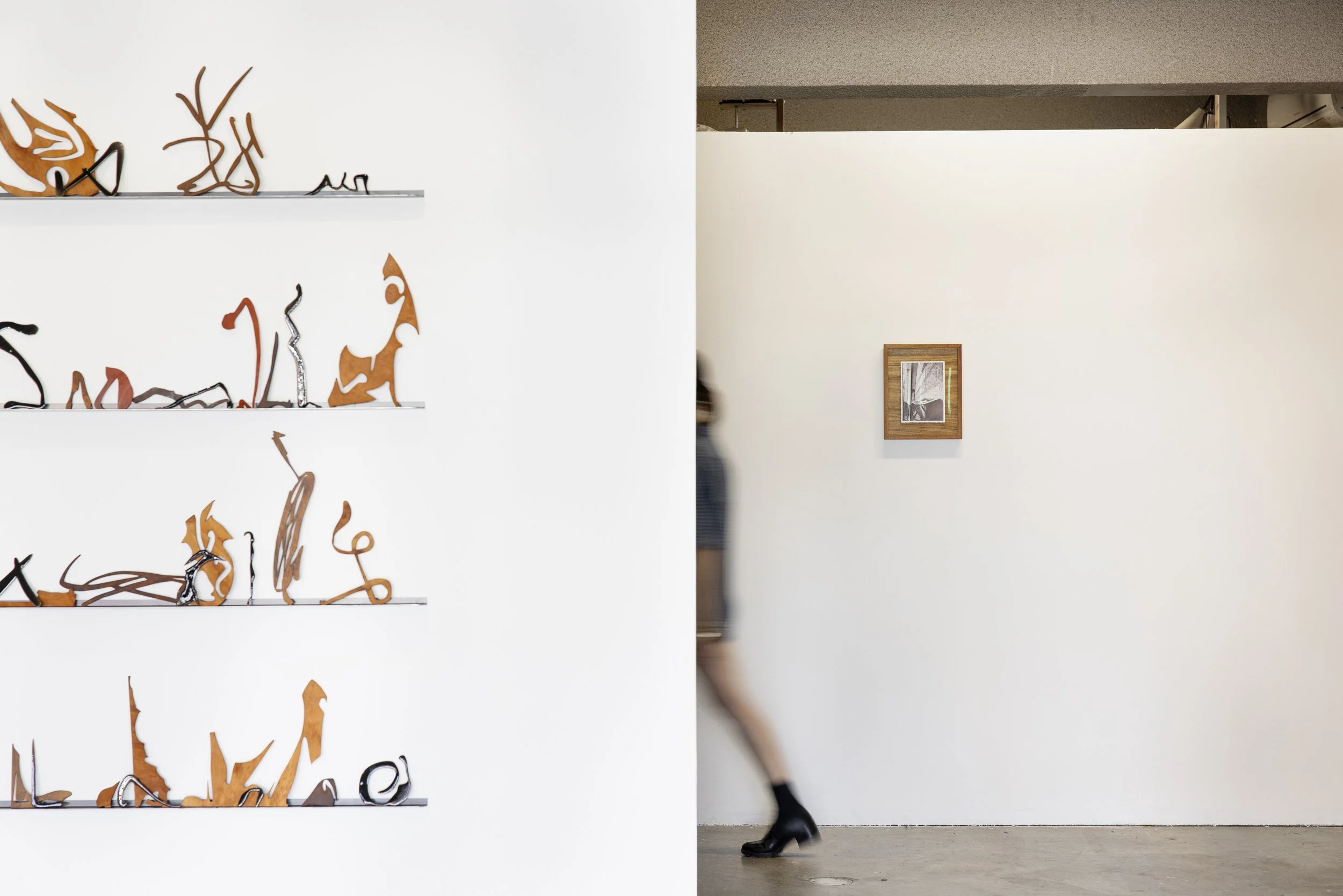
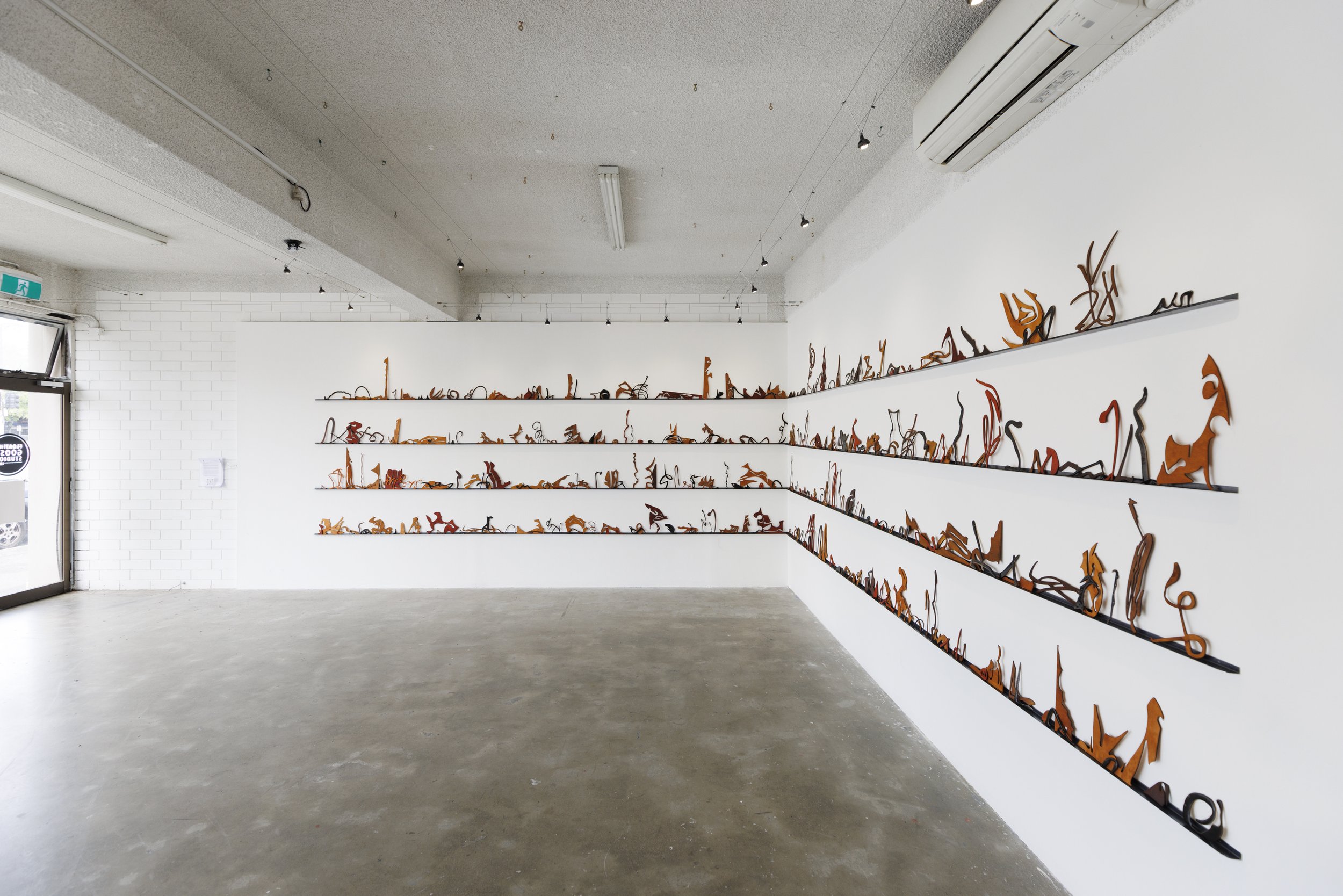
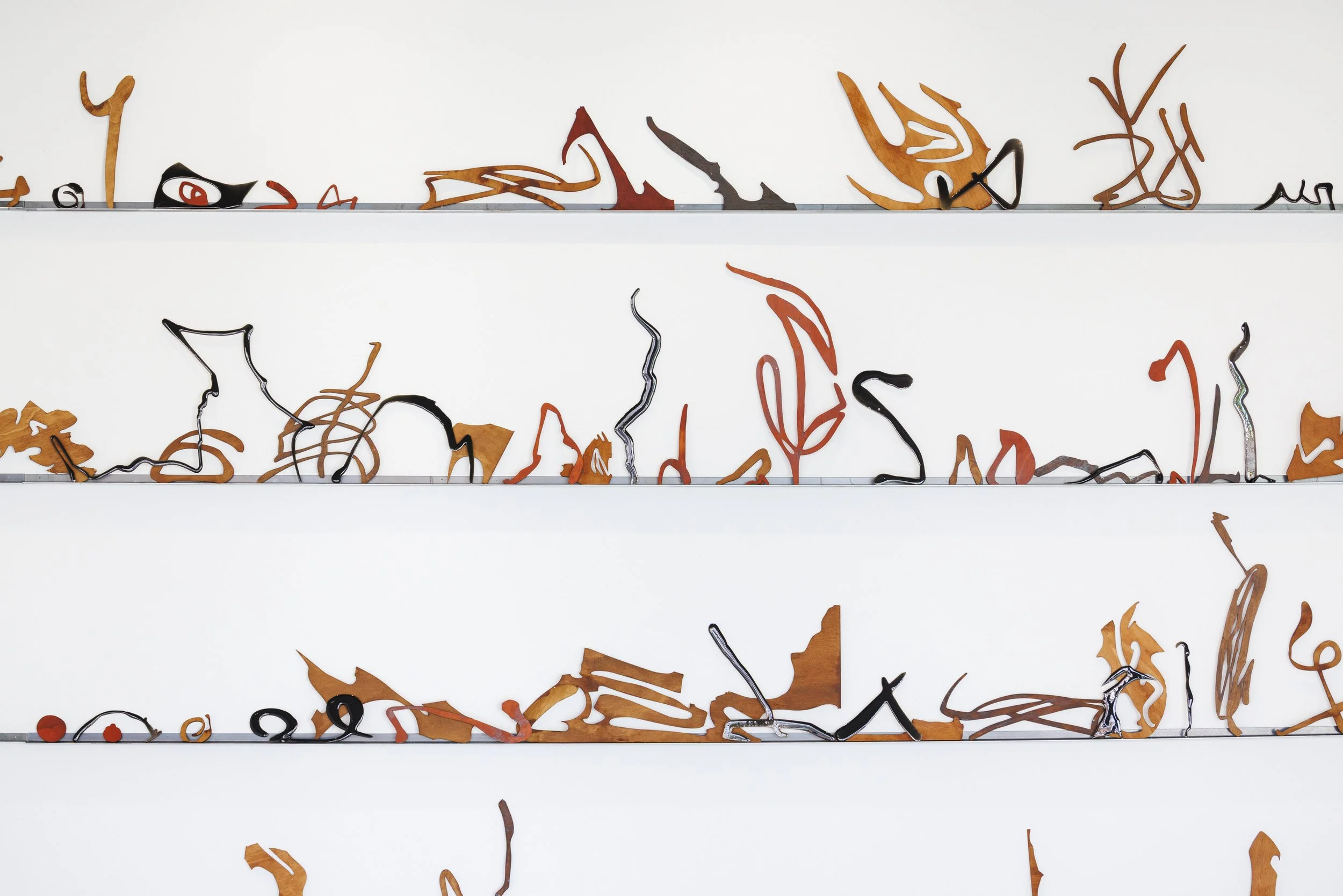
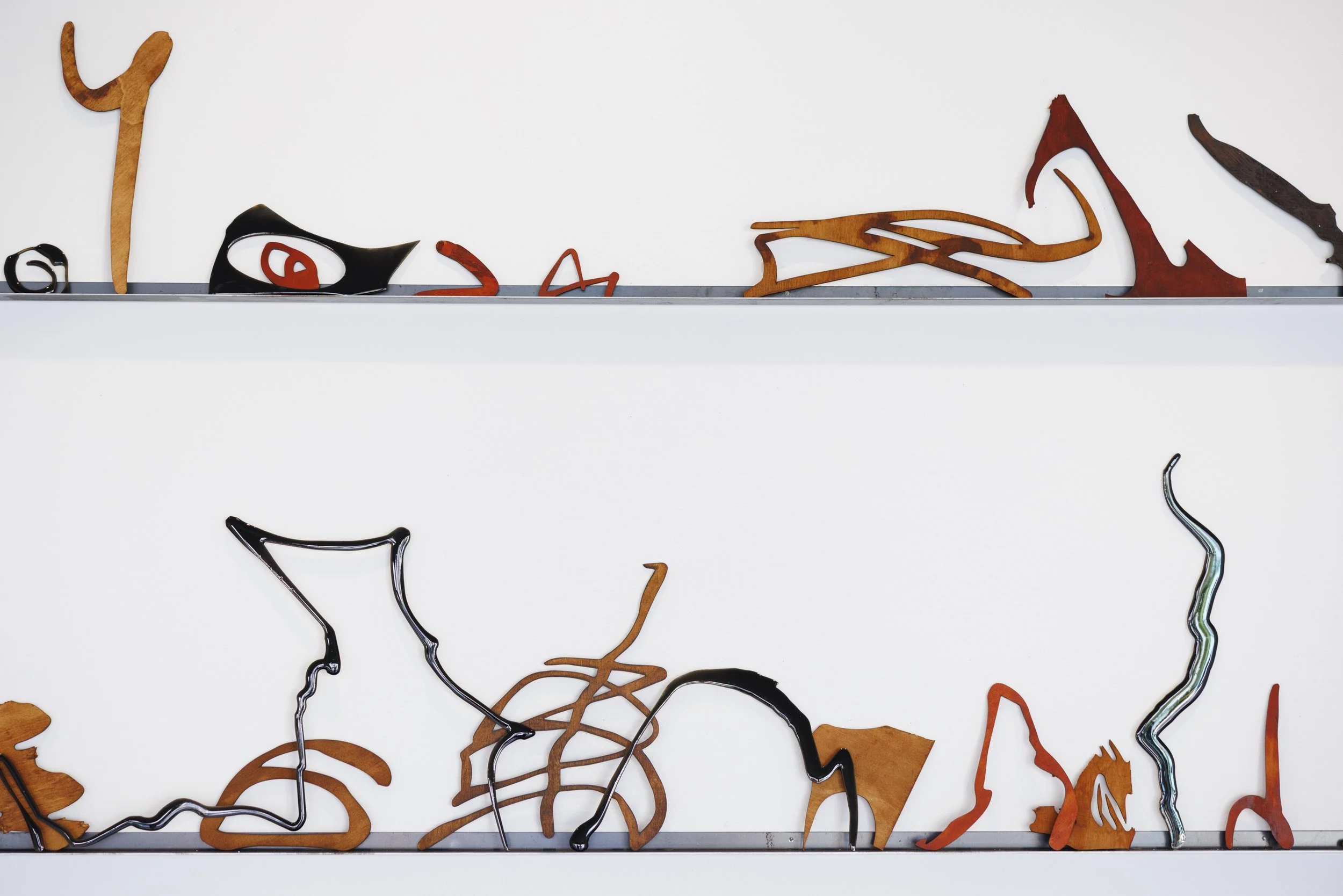
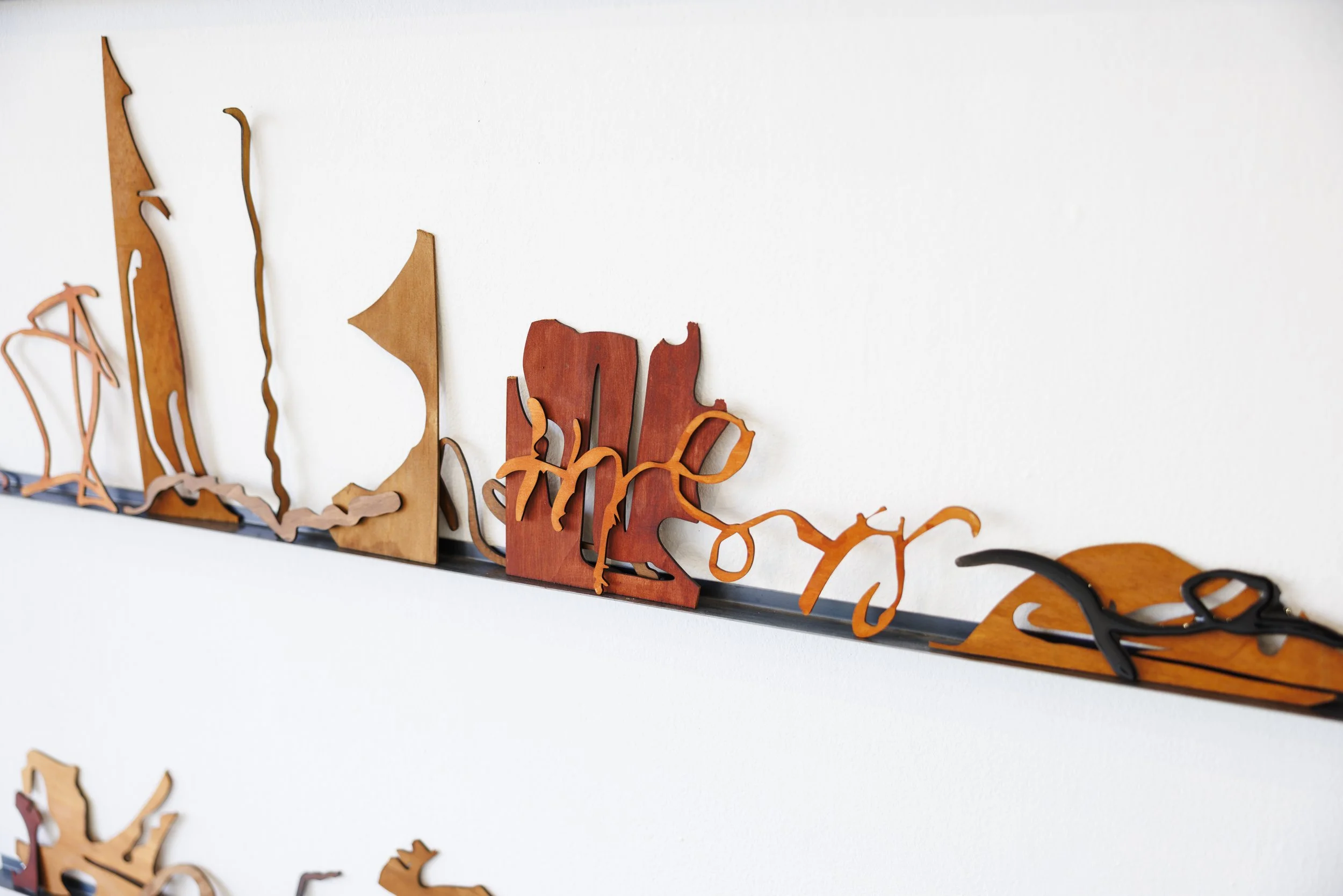
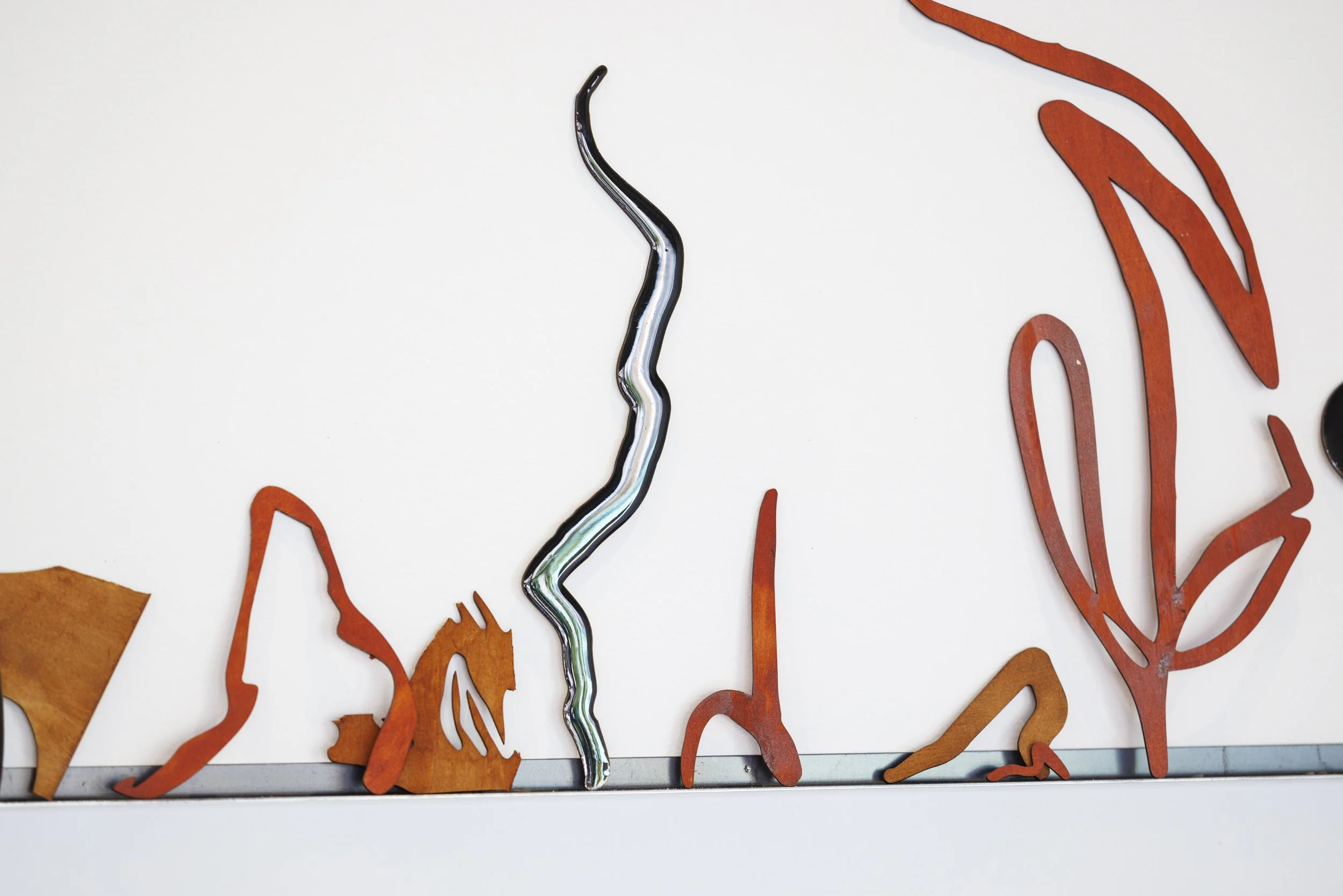
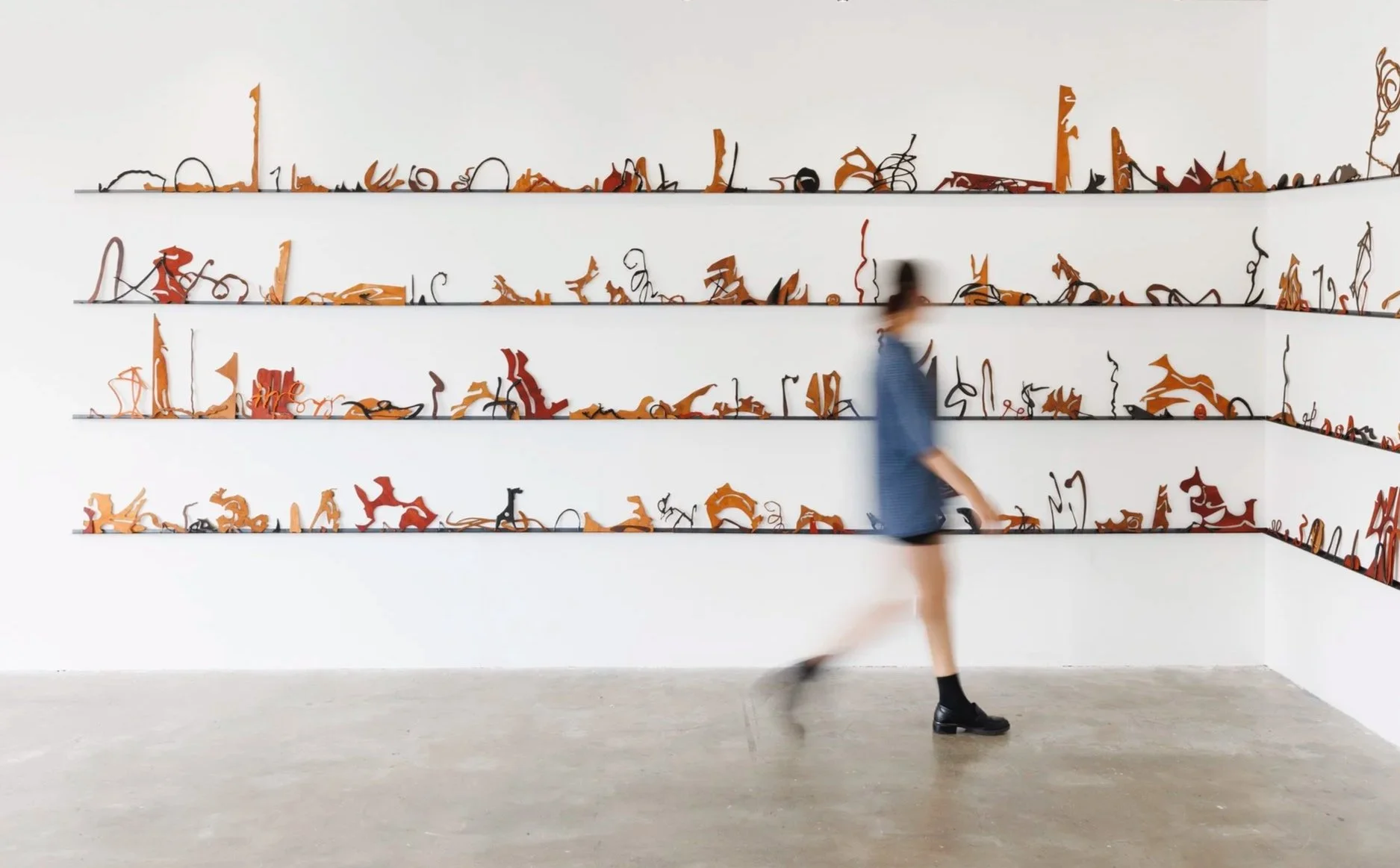
Artist Tia Madden notices this scrawled language across cities in her travels – encompassing Athens, Cairo, and her home city of Western Sydney. Tia documents this graffiti with the specialist eye of a fellow mark-maker, creating an archive of forms. Tia is interested in the linework of these language fragments – the gestural, the squiggly, the looped, and the jagged. These forms are then meticulously recreated in plywood and stained with various resins, forming a strange alphabet in sepia tones. The pieces are carefully arranged along thin metal brackets which evoke letterpress pieces lined up along metal composing sticks. These extended shelves also conjure visions of an old museum archive, with multiple lost languages existing on the same shelf.
The gallery walls, much like the city buildings the original graffiti was scrawled onto, transform into lined paper, complete with ink splotches and a smattering of grammar. In a fitting coincidence, the collective noun for graffiti is a ‘gallery’.
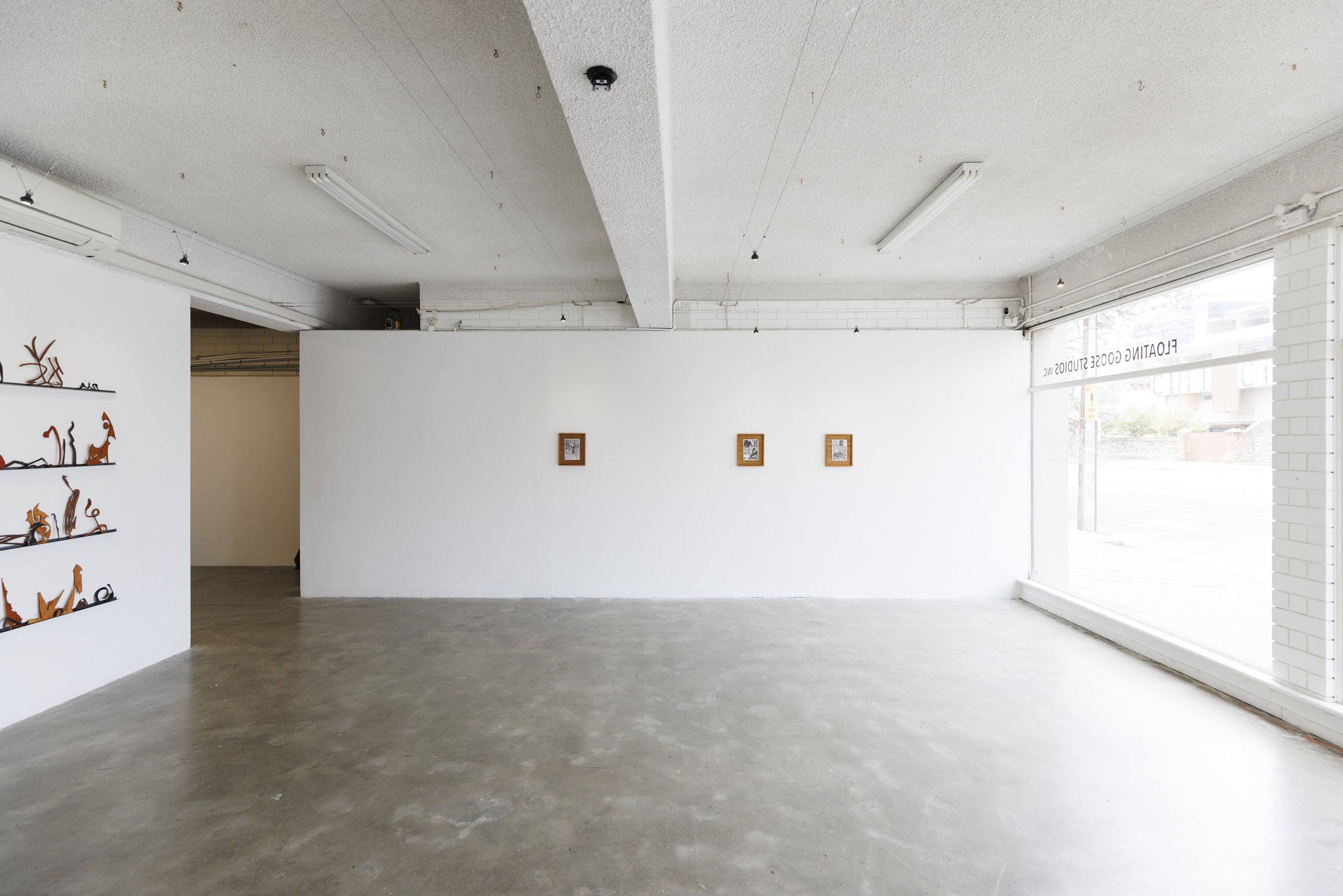
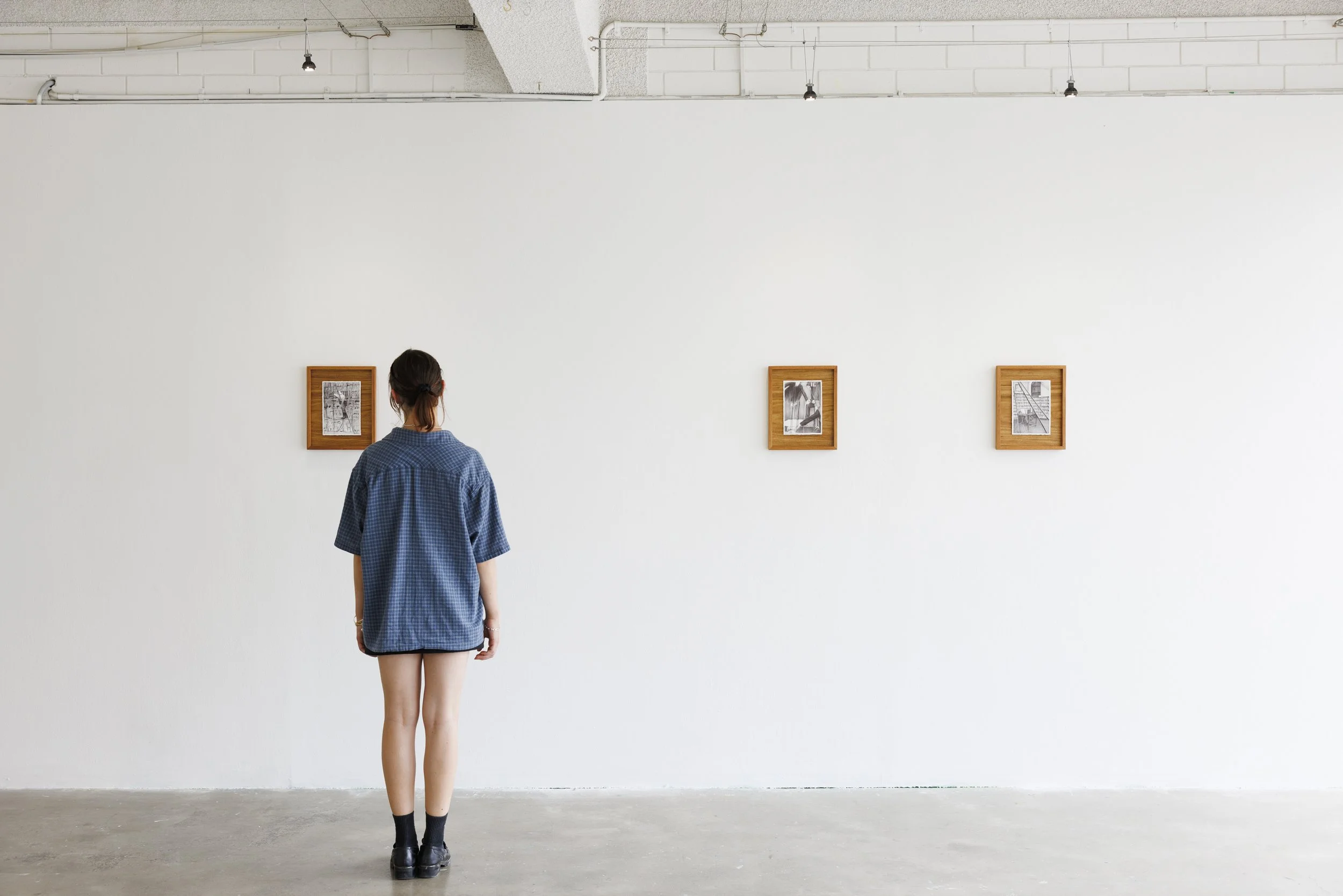
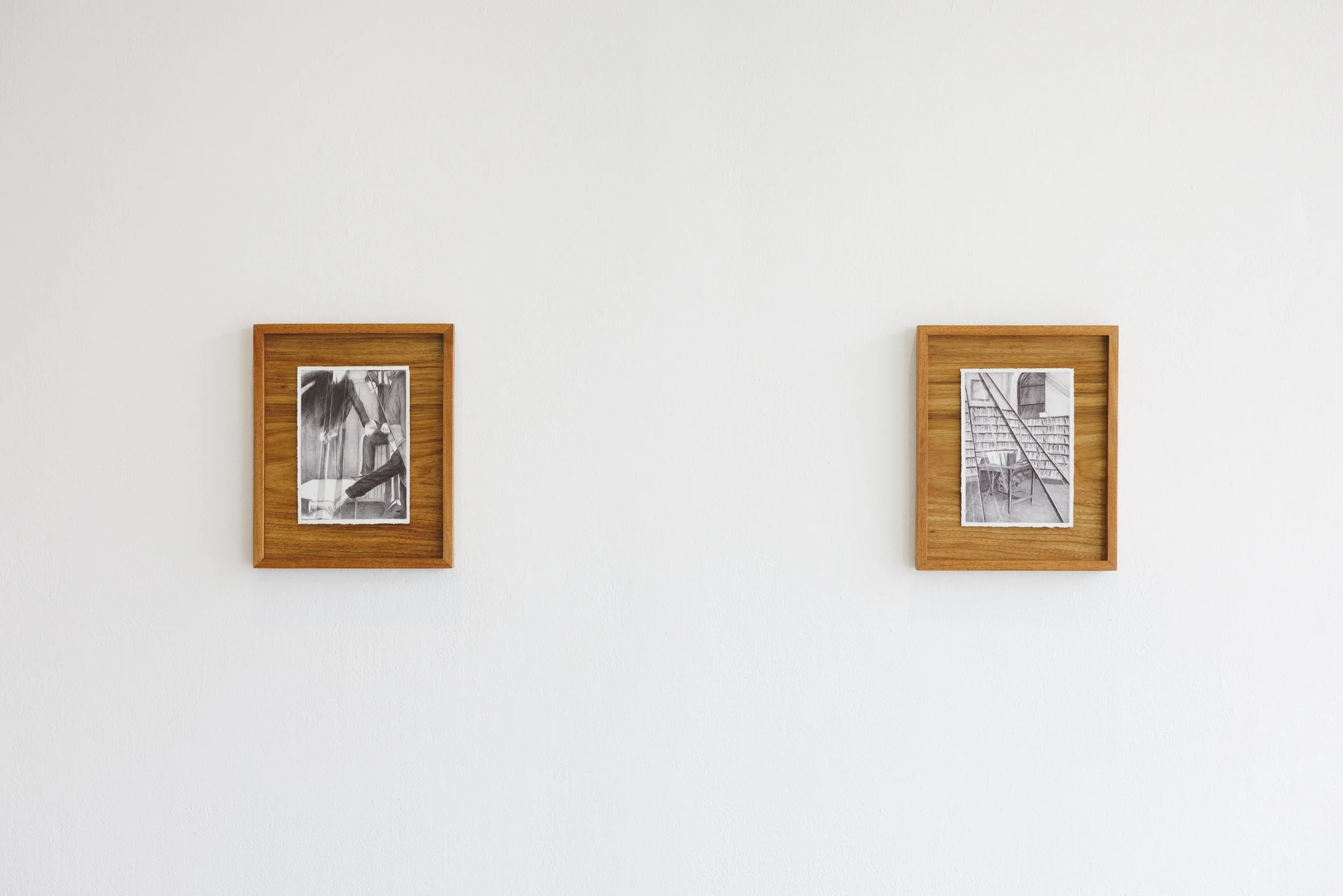
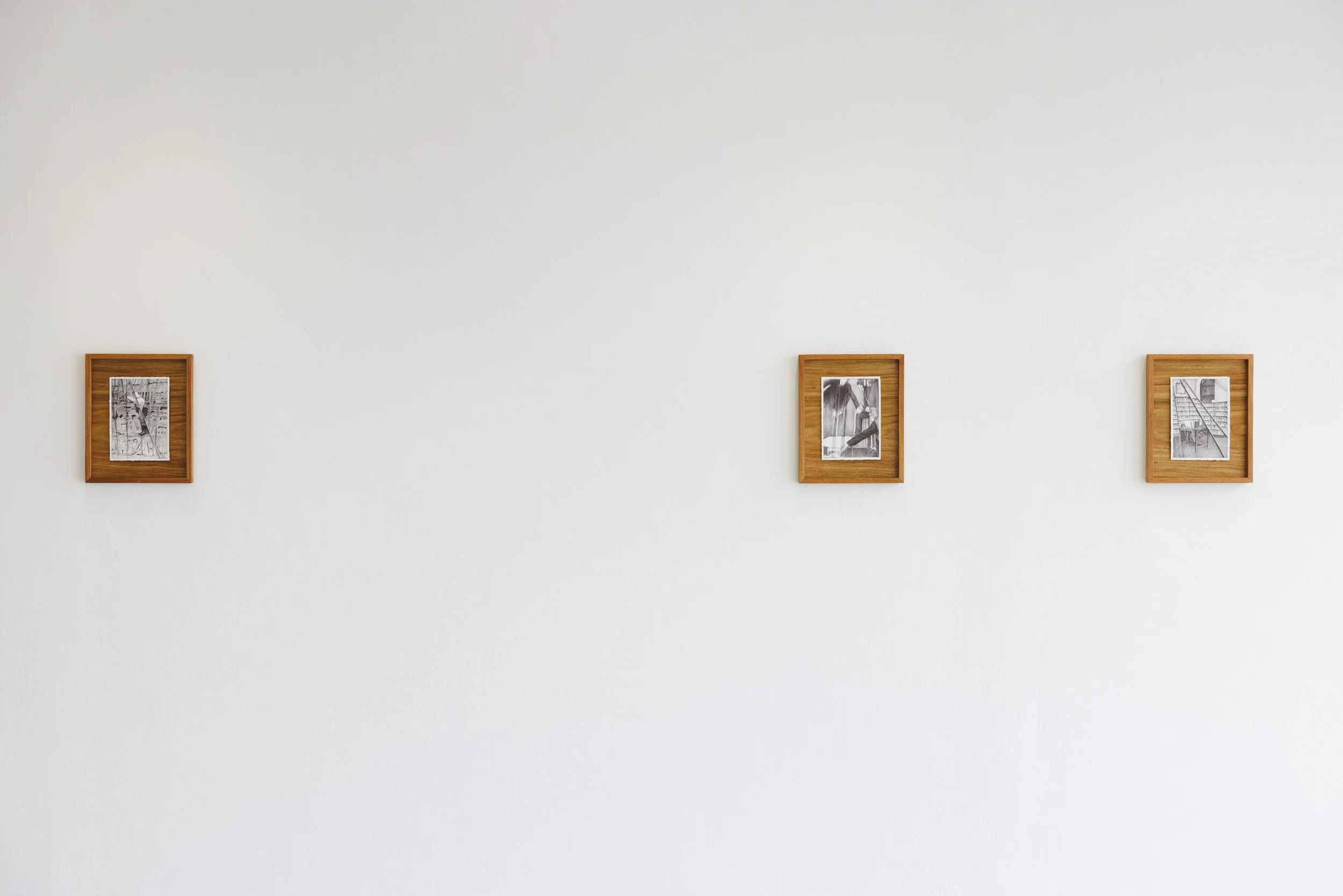
Sharing the space with these forms are small, precise ball-point pen drawings. Each depicts a liminal space – a library, an archaeological site – with visual incursions which fragment and disrupt the image. Strong lines cut through the drawings, creating a gap in visual information, suggestive of a fold or even a scanning misprint. A drawing of multiple men’s suited arms reaching across fragmented space, akin to glass shards, is the most disrupted and curious of the series.
Each drawing, with their miniature scale, deckled edges and meticulous tonal hatching are reminiscent of black and white film photographs from another time and place. The composed pace of these drawings balances the tangled energy of the graffiti forms, providing curious pauses in the show’s score. An extension of grammar.
Standing between these two elements – the jumbled graffiti forms and the punctuated drawings – there is a palpable sense of this grammar: a smooth adherence to a foreign or lost system. The language of archives and cataloguing feels acutely settled among these works, and within Tia’s larger practice. A silent score of information, waiting patiently to be (un)deciphered by some future civilisation – misreading misreading.
Nicole Clift, 2025
Off the streets, graffiti is an unruly, inarticulate, inscrutable scrawl. And although it is oft considered meaningless, with Jean Baudrillard once describing it as “a kind of angular, syncopated writing that no longer says anything at all,” he also wrote that somehow, in all its nothingness, it still says something. It says, ‘I exist somewhere.’
In Misreading Misreading, several hundred of those mute graffitied forms are combined with the material logic of an inked wooden typeset, poised as though composed for a nineteenth-century printing press. The result is a staged tension between an unreadable written script and a technology whose sole purpose is to disseminate clear, reliable information, whilst the audience is positioned not just as a viewer, but a reader.
What it is that a reader does, or is capable of, however, remains relatively obscure. In modern English, we understand the word ‘reader’ to mean ‘one who apprehends the meaning of the written,’ but if we trace the term to its Old English root rǣdere, it returns a definition of the reader as a ‘diviner of riddles’— someone who intuits by guesswork, as one might interpret a dream. Riddles, of course, employ poetic structures but lead astray; they are things with ties to allegories, oracles, paradoxes and dreams, things logic cannot always unweave. And so rather than an act of comprehending something clear-cut, this archaic definition of the reader as a ‘diviner of riddles’ positions reading as a speculative, generative, alchemical practice— something closer to misreading than reading.
Adjacent to the installation, a set of ballpoint pen drawings re-centre the subjectivity, rather than neutrality, inherent in historical practices of ‘reading’: a pair of epigraphers study the then-believed ‘impenetrable’ Egyptian hieroglyphic language through the colonial, othering eye; a librarian offers interpretative guidance to readers; and a group of men communicate with a spirit in a nineteenth-century séance. These images, manually distorted through processes of folding and creasing, destabilise the modern idea of reading as an objective or straightforward process.
And so Misreading Misreading returns us to the uncanny human tendency to conjure meaning where none was intended, re-imagining what possibilities lie within the creative, erroneous, perhaps even prophetic role of the reader. Exploring the potential for abstract marks to behave communicatively when framed – or misread – as language, the exhibition establishes a speculative and poetic dialogue between an audience of misreaders and the graffiti-writing ‘someones’ who exists somewhere – a dialogue that is not entirely of this world, but not apart from it, either – and asks not whether these marks say something true, but what happens when we insist they have something to say at all.